
Introduction
Trade fairs are the most efficient way to meet a large number of Chinese suppliers in a short time. Instead of spending weeks emailing back and forth with potential partners, you can shake hands, examine product samples, and gauge a company’s professionalism in person — all in a single afternoon. China hosts some of the world’s largest trade exhibitions, and for international buyers, three events in particular stand out: the Canton Fair in Guangzhou, the China International Import Expo in Shanghai, and the Hong Kong Electronics Fair.
This guide explains how to attend each of these fairs as a foreign buyer in 2026. It covers registration, visa and entry requirements, what to expect on the ground, and how to prepare so you make the most of your time. For guidance on what to do once you have found a promising supplier, see our guide on how to find reliable Chinese suppliers.
Quick Summary
This guide explains:
- Who this guide is for — international buyers, procurement managers, sourcing agents, and foreign entrepreneurs attending trade fairs in China to find suppliers and explore products
- What you’ll learn — the key details of the three most important trade fairs for foreign buyers in 2026, how to register for each, what visa or entry documents you need, and how to navigate the fairgrounds efficiently
- Key takeaway — trade fairs compress months of supplier research into days of face-to-face meetings. The buyers who get the most out of them are the ones who arrive with a clear plan, pre-register online, and know which halls to visit before they walk through the door
- Recommended action — pre-register for each fair online well before the deadline, book your accommodation early, and prepare a shortlist of target exhibitors from the fair’s online directory before you travel
The Three Most Important Trade Fairs for International Buyers
The Canton Fair (广交会 Guǎngjiāohuì)
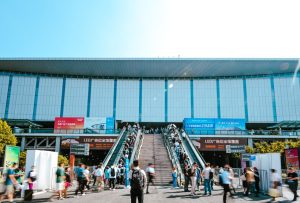
The Canton Fair is the largest trade fair in China and the single most important event for international buyers sourcing from the country. It is held twice a year in Guangzhou, with the autumn 2026 edition running from October 15 to November 4. The fair is divided into three phases, each covering different product categories. Phase 1 runs from October 15 to 19 and covers industrial equipment, new energy vehicles, hardware tools, electronics, and automation. Phase 2 runs from October 23 to 27 and covers furniture, kitchen and bath products, ceramics, gifts, and home décor. Phase 3 runs from October 31 to November 4 and covers food, textiles and apparel, luggage, sports and leisure products, and health and personal care items.
Between each phase, the exhibition complex closes entirely for reconfiguration. No visitors are admitted during these changeover periods. Plan your trip accordingly — if your target product category is in Phase 1 and Phase 3, you will need to stay in Guangzhou for nearly three weeks or make two separate trips. The fair spans 1.55 million square meters of exhibition space, hosts over 32,000 exhibitors across 54 industry zones, and fills 75,700 booths. Registering in advance is the single most important thing you can do. The Canton Fair now accepts foreign buyer pre-registration year-round through its official website. Complete the three-step process — register and log in, confirm your details, and fill in the pre-registration questionnaire — and you can collect your badge in about 30 seconds at a service point in the exhibition complex, at the airport, or at designated hotels.
The China International Import Expo (CIIE)
The China International Import Expo is held in Shanghai from November 5 to 10, 2026 at the National Exhibition and Convention Center. Unlike the Canton Fair, which focuses on Chinese companies exporting to the world, CIIE is the world’s first national-level exhibition themed on imports — it is designed to help foreign companies sell into the Chinese market. For international buyers, this means CIIE is valuable in a different way. It is a place to understand the competitive landscape in China, see which global brands are active in your industry, and meet potential distribution partners.
Professional visitor registration for the 9th CIIE opened on May 28, 2026. The registration deadline is October 20 at 24:00 Beijing time, and the payment deadline is October 23 at 24:00. Do not leave this to the last minute. CIIE has introduced a fully digital badge system for its 9th edition — overseas visitors can apply online with their passport and receive an electronic pass without needing to collect a physical card. The expo is divided into six enterprise exhibition zones: technical equipment, automobiles and smart mobility, consumer goods, medical devices and healthcare, food and agricultural products, and trade in services.
The Hong Kong Electronics Fair (Autumn Edition)
The Hong Kong Electronics Fair, organized by the Hong Kong Trade Development Council, is the strongest event in Asia for consumer electronics, components, and technology products. The physical exhibition runs from October 13 to 16, 2026 at the Hong Kong Convention and Exhibition Centre. Online business matching runs from October 6 to 23, and the HKTDC sourcing platform is accessible from September 13 to November 12. This schedule allows buyers to attend the Hong Kong fair and the Canton Fair in a single trip — the fairs are close enough in timing and geography to combine. The fair is for trade professionals only. Visitors must be 18 or older. If you pre-register online before the event, entry is free. If you register on-site, there is a 100 HKD admission fee. Pre-register.
Before You Travel: Registration, Visas, and Logistics
Register for Your Buyer Badge Online Before You Leave Home
All three fairs allow foreign buyers to pre-register online. For the Canton Fair, the official website at cantonfair.org.cn is the only registration channel — there is no on-site registration for first-time visitors without a pre-registration. Complete the process online, print or save your confirmation, and collect your physical badge when you arrive. For CIIE, register through the official website at ciie.org before the October 20 deadline, pay the registration fee before October 23, and you will receive a digital pass. For the Hong Kong Electronics Fair, pre-register through the HKTDC website to secure free entry and avoid the 100 HKD on-site fee.
Visa and Entry Requirements
Your visa situation depends on your nationality and which fair you are attending. Travelers from the 50 countries eligible for China’s unilateral 30-day visa-free policy — including most European nations, Australia, New Zealand, Japan, South Korea, Brazil, Canada, and the UK — can enter mainland China for the Canton Fair or CIIE without a visa. Your fair pre-registration confirmation can serve as supporting documentation of your business purpose if asked by immigration, though it is not a substitute for a valid passport or, where applicable, a visa.
Travelers from the 55 countries eligible for the 240-hour transit visa-free policy can use this for fair attendance as well, provided they hold an onward ticket to a third country or region. For both fairs, ensure your passport has at least six months of validity remaining. If you need a business visa, known as the M visa, the fair organizer can usually provide an invitation letter once you have registered. For a complete guide to visa options, see our article on how to apply for a Chinese business visa. Hong Kong has its own separate immigration system. Many nationalities can enter Hong Kong visa-free for periods ranging from 7 to 180 days. Check the Hong Kong Immigration Department website for your specific nationality before traveling.
Book Accommodation Early
Hotel rooms near the fairgrounds fill up quickly during major exhibitions. During the Canton Fair, hotel prices in Guangzhou can double or triple. Book your room as soon as you have your fair dates confirmed — ideally at least a month in advance for the Canton Fair. Staying near a metro station on the same line as the exhibition center is a practical alternative to staying directly next to the fairground. For more on booking accommodation, see our guide on how to book hotels for a business trip in China.
Navigating the Fairgrounds: Practical Tips
Getting Connected
The Canton Fair exhibition complex provides free Wi-Fi. Connect to the network named “Canton Fair Free WiFi” and choose the QR code login option. Scan your buyer badge barcode, and you are connected without needing a mainland Chinese mobile number. This is the preferred method for foreign buyers. A text message login option also exists but requires a Chinese phone number. CIIE and the Hong Kong Convention and Exhibition Centre also provide free Wi-Fi throughout their venues. For broader connectivity advice, see our guide on how to get internet in China as a foreigner.
Payment and Currency
At the Canton Fair, currency exchange machines in the exhibition complex support eight currencies: US dollars, euros, British pounds, Japanese yen, South Korean won, Hong Kong dollars, Australian dollars, and Canadian dollars. Over 15,000 merchants in the surrounding area accept international bank cards. That said, inside the exhibition halls, having Alipay or WeChat Pay set up on your phone is still the most reliable way to pay for food, drinks, or any incidental purchases. For payment setup help, see our guides on how to use Alipay in China as a foreigner and how to use WeChat Pay in China.
Getting to the Fairgrounds
For the Canton Fair, Guangzhou Metro Line 8 serves both Xingang Dong Station and Pazhou Station, both of which are directly connected to the exhibition complex. This is the simplest and most reliable way to reach the fair. Taxis and ride-hailing services are also available, but traffic around the complex during fair hours is heavy. For CIIE in Shanghai, Metro Line 2 and Line 17 both serve the National Exhibition and Convention Center. The Hong Kong Convention and Exhibition Centre is accessible by MTR, bus, and ferry from various points in Hong Kong.
Plan Your Booth Visits Before You Arrive
The Canton Fair alone has thousands of exhibitors. Walking the floor without a plan wastes valuable time. Before you travel, use the fair’s online exhibitor directory to search for companies in your product category. Make a shortlist of the booths you want to visit, organized by hall and phase. A realistic target is 10 to 15 meaningful conversations per day — any more and the conversations start to blur together. Take notes immediately after each meeting. After three days of back-to-back supplier meetings, the details will run together if you rely on memory alone.
Bring More Business Cards Than You Think You Need
You will exchange cards constantly. Bring at least twice as many as you think you will need, and keep them in a professional card holder, not loose in your pocket. Present your card with both hands, Chinese side facing up if it is bilingual. When you receive a card, take a moment to look at it before putting it away. For a full guide to the card exchange ritual, read our article on how to give and receive business cards in China.
Making the Most of Your Fair Conversations
Lead With a Specific Question
The most effective way to start a conversation at a trade fair booth is with a question that shows you have done your homework. Instead of “What does your company make,” try “I saw on your website that you specialize in this category. We are looking for a supplier who can handle this specific requirement. Is that something your factory can support?” This immediately distinguishes you from casual visitors and gives the booth representative a clear starting point for a substantive discussion.
Evaluate More Than the Product
The product samples at the booth tell you what the supplier is capable of making. The way the booth staff communicate tells you what they will be like to work with. Do they answer your questions directly? Do they ask about your market and your requirements, or do they push for a quick order without understanding what you need? A supplier that communicates well at a trade fair is far more likely to be easy to work with once money is involved. For a framework on evaluating suppliers after the fair, see our guide on how to evaluate a Chinese supplier before placing your first order.
Follow Up Within 48 Hours
The conversations you have at a trade fair have a short shelf life. By the end of the week, the supplier has talked to dozens of buyers, and your discussion is one of many. Send a follow-up message within 48 hours — ideally on WeChat, which is how most Chinese suppliers prefer to communicate. Reference something specific from your conversation to jog their memory: “It was good to meet you at the Canton Fair yesterday. I was the buyer asking about the ceramic coating on your samples.” For more on maintaining these relationships after the fair, see our guide on how to use WeChat for business in China.
Frequently Asked Questions
Can I attend Chinese trade fairs without a visa?
It depends on your nationality. Travelers from 50 countries can enter China visa-free for up to 30 days and attend the Canton Fair or CIIE without a visa. Travelers from 55 countries can use the 240-hour transit visa-free policy if they hold an onward ticket to a third country. If your country is not on either list, you will need a business visa. The fair organizer can usually provide an invitation letter to support your visa application once you have registered.
Do I need to register in advance, or can I register at the door?
You must register in advance. The Canton Fair requires online pre-registration before you arrive — there is no walk-up registration for first-time international buyers. CIIE has a strict registration deadline of October 20, 2026. The Hong Kong Electronics Fair allows on-site registration, but it costs 100 HKD, whereas pre-registration is free. Pre-register for all three.
How many days should I plan to spend at a trade fair?
For the Canton Fair, plan at least two full days per phase for the product categories you are interested in. If you are sourcing across multiple phases, you will need to account for the changeover periods when the exhibition complex is closed. For CIIE, two to three days is sufficient for most buyers. For the Hong Kong Electronics Fair, one to two days is usually enough given its more focused scope.
Can I buy samples at Chinese trade fairs?
Many exhibitors sell or give away samples, particularly on the last day of each phase when they prefer not to pack everything up and ship it back to their factory. If you are interested in a product, ask whether the booth sample is available. Be prepared to pay for it and arrange your own shipping or carry it with you.
Conclusion
Attending a trade fair in China is one of the highest-return investments of time and money an international buyer can make. Register online before you travel. Know which halls and booths you want to visit before you walk through the door. Bring more business cards than you think you need. And follow up within 48 hours of every conversation that matters. The buyers who treat a trade fair as a structured business exercise rather than a browsing trip are the ones who leave with a supplier shortlist and a clear path to their next order.
Once you have found promising suppliers at a fair, the next steps are due diligence and negotiation. For a complete guide to what comes next, read our articles on how to conduct supplier background checks in China and how to negotiate with Chinese suppliers.
- Master workplace and negotiation expressions in our Business Chinese collection.
- Get personalized one-on-one business Mandarin training with our Premium Chinese Live Courses.
- For corporate sourcing, cross-cultural training and custom projects, learn about our Business Consultancy Service.
- Explore curated travel, business and learning resources in our Premium Chinese Materials.
Disclaimer: This guide is for informational purposes only and does not constitute legal, financial, or investment advice. While we strive to provide accurate and up-to-date information, laws and policies change frequently, and we cannot guarantee the accuracy of all content. International investors should always consult with qualified legal, financial, and tax professionals before making any business decisions in China.