
Introduction
Chongqing (重庆, Chóngqìng) is a vertical city built on steep hills where rivers meet. It is famous for spicy hotpot, neon-lit night views, and a transportation system that routinely baffles smartphone maps. For a first-time visitor, Chongqing is chaotic but deeply rewarding. The city is dense, the terrain is extreme, and the popular attractions require precise timing to avoid overwhelming crowds. This guide reflects the situation as of October 2026. It covers how to navigate the “8D” topography, which attractions require advance booking, how to order hotpot without burning your palate, and the logistics for day trips to Wulong or Dazu.
The sections below move from arrival and city navigation to food, accommodation, and itinerary planning.
Quick Answer
Plan for 3 days to cover the main urban highlights, plus 1 additional day if you want to visit the Wulong Karst or Dazu Rock Carvings. The city is best explored using the metro and taxis, as walking between nearby map points often involves climbing hundreds of stairs. Must-do experiences include seeing the illuminated Hongya Cave (洪崖洞, Hóngyádòng) at night, riding the Yangtze River Cableway (长江索道, Chángjiāng Suǒdào), and eating a traditional nine-grid hotpot (九宫格, jiǔgōnggé). Spring (March to May) and autumn (September to November) are the best times to visit; avoid the extreme heat of July and August.
How to Navigate the “8D” City
Understanding the Terrain
Chongqing is famously called an “8D” city. A location that appears 100 meters away on a map might actually require a 20-minute walk up multiple flights of stairs, through a shopping mall, and across a pedestrian bridge. Do not trust the straight-line distance on Google Maps or Apple Maps. Instead, use Amap (高德地图, Gāodé Dìtú) or Baidu Maps, and always check whether your route involves stairs or steep slopes. Wear flat, comfortable shoes. If you are carrying heavy luggage, take a taxi rather than attempting to navigate metro station transfers with stairs.
Metro and Taxis
The Chongqing Rail Transit is the most reliable way to cross the city. As of 2026, the fare structure is distance-based, starting at 2 RMB and capping at 10 RMB, with a current promotional cap of 7 RMB for unlimited travel. You can buy single-journey tickets at machines, which now accept foreign credit cards. Alternatively, you can scan Alipay or WeChat Pay QR codes directly at the gates. For a full setup guide, see our article on how to use Alipay in China for foreigners.
Taxis are affectionately called “yellow Ferraris” (黄色法拉利, huángsè fǎlālì) by locals due to their bright yellow color and aggressive driving style. The daytime flagfall (6:00 to 23:00) is 10 RMB for the first 3 km, then 2 RMB per kilometer. At night, the flagfall rises to 11 RMB, and the rate increases to 2.3 RMB per kilometer. Ride-hailing apps like Didi work well, but you must set your pickup pin exactly at a specific landmark (such as a mall entrance or a specific metro exit), not just the street name.
Top Attractions and Booking Rules
Hongya Cave (洪崖洞)
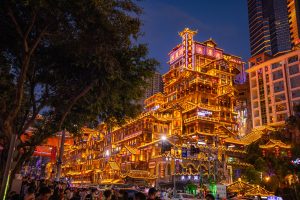
Hongya Cave is a massive stilted complex built into the cliffside. It is free to enter, but it is extremely crowded. As of 2026, entry is open from 9:00 to 23:00. On weekends and public holidays, you must reserve a free entry slot through the official “Hongya Cave” WeChat account up to 5 days in advance. The lights turn on at 18:30 and shut off at 23:00. The best photo spot is not inside the complex, but from the Qiansimen Bridge (千厮门大桥, Qiānsīmén Dàqiáo) or the riverside across the river.
Yangtze River Cableway (长江索道)
The cableway offers a 5-minute ride across the Yangtze River. As of 2026, a single ride is 30 RMB, and a round trip is 50 RMB. Operating hours change seasonally: peak season (March 1 to October 31) is 7:30 to 22:30, and off-season (November 1 to late February) is 7:30 to 21:30. Tickets must be booked via the “Yangtze River Cableway” WeChat account. The system assigns you a virtual queue number, which reduces physical waiting time. Note that the cableway has 1-2 days of maintenance shutdown per month; always check their official WeChat announcement on the day of your visit.
Liziba Station (李子坝) and Ciqikou (磁器口)
Liziba is the famous spot where Metro Line 2 passes directly through a residential building. The viewing platform outside the station is free, requires no reservation, and is open from 6:30 to 23:00. You only need 20 to 40 minutes here. Ciqikou is a historical town with traditional architecture. It is free to enter and does not require a reservation. While the main street is highly commercialized, you can buy local snacks like twisted dough rolls (麻花, máhuā) for around 10 RMB per bag.
Nanshan One Tree (南山一棵树) and Red Crag Sites
For panoramic views of the city skyline, Nanshan One Tree is the best spot. As of 2026, tickets are 30 RMB during peak season and 15 RMB in winter. Opening hours are seasonal: 9:00 to 23:00 (May to October) and 9:00 to 22:30 (November to April). Arrive one hour before sunset. For historical sites like the Baigongguan and Zhazidong prisons, reservations are no longer required as of 2026. You can enter directly by scanning your ID card. Foreign passport holders should confirm the registration process via the “Red Crag Museum” WeChat account in advance.
Hotpot and Food Culture
How to Order Hotpot
Chongqing hotpot is not just food; it is a communal event. The soup base is made of beef tallow and Sichuan peppercorns. If you cannot handle intense spice, order a “yin-yang pot” (鸳鸯锅, yuānyāngguō) which divides the pot into spicy and non-spicy sections. When locals say “mild spice” (微辣, wēilà), it is still significantly hotter than most international definitions of spicy. Expect to pay 38 to 68 RMB for the soup base, and 4 to 8 RMB per person for the oil dipping sauce (油碟, yóudié).
The classic hotpot uses a nine-grid pot. The center grid has the highest heat and is for quick-boiling items like tripe (毛肚, máodù, 15 seconds) and duck intestines (鸭肠, yācháng). The cross grids are for medium-heat cooking, and the corner grids are for slow simmering. The standard dipping sauce is a mix of sesame oil, minced garlic, oyster sauce, and cilantro; locals rarely add vinegar.
Local Snacks and Drinks
Besides hotpot, you must try Chongqing noodles (小面, xiǎomiàn). A bowl usually costs 8 to 12 RMB. When ordering, locals say “二两,提黄” (èr liǎng, tí huáng), which means a standard portion with slightly undercooked noodles for a firmer texture. Another local favorite is hot and sour rice noodles (酸辣粉, suānlàfěn). To cool down the heat, drink local soy milk (唯怡豆奶, Wéiyí dòunǎi), which is available at almost every hotpot restaurant. For more regional dishes, see our guide on what to eat in China.
Where to Stay and Day Trips
Choosing an Accommodation Area
The Jiefangbei (解放碑, Jiěfàngbēi) area is the most convenient for first-time visitors, as it is within walking distance of Hongya Cave and the cableway. However, it is extremely noisy at night. If you prefer quiet, stay along Nanbin Road (南滨路, Nánbīn Lù) on the south bank, which offers excellent views of the skyline across the river. A critical rule for foreign travelers: not all hotels in China are licensed to host foreign passport holders. When booking, look for properties marked “Foreign Guest Accepted” (涉外, shèwài). For more details, read our guide on whether foreigners can check in to any hotel in China.
Day Trips: Wulong vs. Dazu
If you have an extra day, you must choose between Wulong and Dazu. You cannot do both comfortably in one day. Wulong Karst (武隆, Wǔlóng) is famous for the Three Natural Bridges, where scenes from “Transformers” were filmed. The high-speed train from Chongqing East Station takes about 30 to 40 minutes, followed by a shuttle bus. The ticket is 125 RMB in the off-season (November to February) and 155 RMB in peak season, which includes the internal shuttle and elevator. Dazu Rock Carvings (大足, Dàzú) is a UNESCO World Heritage site featuring ancient Buddhist cliff sculptures. The train from Chongqing West Station takes about 40 to 60 minutes. The combined ticket for Baodingshan and Beishan is 140 RMB in peak season. Both trips are doable, but Wulong involves more walking. For intercity train bookings, see our guide on how to take high-speed rail in China.
Common Problems and Solutions
I am lost and cannot find the entrance to my hotel
- Cause: The 8D topography means street level is different for every building. A hotel might be on the 15th floor when accessed from one street, but on the 1st floor when accessed from another.
- Solution: Contact the hotel and ask them to send their location via WeChat. They can share a precise pin or send text directions that include which floor to exit the metro station and which elevator to take. Do not attempt to navigate based on a street address alone.
The cableway or Hongya Cave is closed for repairs
- Cause: Both attractions conduct routine maintenance or crowd control measures, which are announced at short notice.
- Solution: Always follow the official WeChat accounts for real-time updates. If Hongya Cave is too crowded at night, you can get a great view of it from across the river at Nanbin Road. If the cableway is closed, take the metro across the river and visit the Nanshan viewing platform instead.
Real-Life Tips
- Download an offline map before you arrive. Google Maps does not work reliably in China, and cell signal can be weak in underground metro stations.
- Carry tissues. Many public toilets and local restaurants do not provide toilet paper.
- If you have a sensitive stomach, bring digestive medication. The transition to very spicy and oily hotpot can be a shock to your system.
- Skip the “internet-famous” bamboo cup milk tea. It is usually overpriced and not a traditional local drink. Try local soy milk instead.
- When using ride-hailing apps, pin your location at a recognizable building entrance or a specific metro exit number. Never pin an intersection.
Common Mistakes to Avoid
- Avoid trying to walk from Liziba to Eling Park without being prepared for steep stairs. Take a taxi or use the metro.
- Never buy cableway tickets or river cruise tickets from street touts (黄牛, huángniú). Always book through official WeChat mini-programs.
- Do not book a hotel without confirming it accepts foreign passports. Many local guesthouses lack the license.
- Avoid assuming “mild” hotpot will taste like regular soup. The numbing peppercorns (花椒, huājiāo) create a unique sensation.
- Do not wear high heels or hard-soled shoes. The city is full of slopes, stairs, and uneven pavement.
Useful Chinese Phrases
- 洪崖洞 (Hóngyádòng) — Hongya Cave
- 长江索道 (Chángjiāng Suǒdào) — Yangtze River Cableway
- 九宫格 (jiǔgōnggé) — nine-grid hotpot
- 微辣 (wēilà) — mild spice (still very spicy)
- 鸳鸯锅 (yuānyāngguō) — yin-yang hotpot (half spicy, half mild)
- 多少钱?(duōshao qián?) — How much is it?
- 我不要香菜 (wǒ bùyào xiāngcài) — I do not want cilantro
Frequently Asked Questions
How many days do I need in Chongqing?
Three days is sufficient for the urban highlights. Day one can cover Jiefangbei, Hongya Cave, and the cableway. Day two can be spent at Ciqikou and Nanshan. Day three is for a day trip to Wulong or Dazu. If you want to explore both Wulong and Dazu, or take a Yangtze River cruise, you need at least five days. Chongqing pairs well with Chengdu; the high-speed train takes as little as 62 minutes.
Is Chongqing safe for foreign tourists?
Chongqing is generally very safe, even at night. The main risks are minor scams, such as unofficial taxis overcharging or touts selling fake tickets to the cableway. The biggest physical risk is the terrain: watch your step in wet weather, as stone stairs and steep slopes can be slippery. Keep your belongings secure in crowded tourist areas like Hongya Cave. Emergency numbers are 110 for police and 120 for medical assistance.
Do I need to speak Chinese to visit Chongqing?
You do not need to speak Chinese, but you should have a translation app ready. English is less widely spoken in Chongqing than in Shanghai or Beijing, especially in local hotpot restaurants and taxis. A smartphone with translation software, a map app, and Alipay will solve most problems. At hotpot restaurants, pointing at dishes and using the picture menus is a standard and acceptable way to order.
Can I visit Wulong and Dazu in one day?
No, attempting to visit both in one day is not recommended. Wulong is about 2.5 to 3 hours of travel and walking, while Dazu involves significant walking across different sites. Each requires a full day when accounting for round-trip train travel and internal shuttles. Choose one based on your interests: Wulong for dramatic natural karst landscapes, and Dazu for ancient Buddhist rock carvings.
Conclusion
Chongqing is a city of contrasts: futuristic infrastructure built into ancient hills, and fiery hotpot served in noisy, welcoming restaurants. Navigating the “8D” terrain and booking the right attractions in advance will save you time and frustration. Plan for three days, embrace the steep walks, and use the metro to bypass traffic. The city rewards those who step off the beaten path.
If you are combining Chongqing with other destinations, explore our guides on how to visit Chengdu as a first-time traveler and the best destinations for first-time visitors to China.
- Master workplace and negotiation expressions in our Business Chinese collection.
- Get personalized one-on-one business Mandarin training with our Premium Chinese Live Courses.
- For corporate sourcing, cross-cultural training and custom projects, learn about our Business Consultancy Service.
- Explore curated travel, business and learning resources in our Premium Chinese Materials.
Disclaimer: This guide is for informational purposes only and does not constitute legal, financial, or investment advice. While we strive to provide accurate and up-to-date information, laws and policies change frequently, and we cannot guarantee the accuracy of all content. International investors should always consult with qualified legal, financial, and tax professionals before making any business decisions in China.